Goals
The goal of this project was to create a feasible and robust set of ideas that UCSB could potentially implement to reduce greenhouse gas emissions related to commuting and air travel. Transportation serves as one of the university’s biggest emission sources. It is also an area that UCSB is still seeking new solutions to address. Through this project the team hoped to demonstrate the many options available to the campus. They then sought to get feedback on which ideas the campus wanted to prioritize for deeper feasibility analysis. In 2026-2027, several ideas developed in this project will be taken to the next stage of planning and some will be put into action.
Deliverables
Lainey and Ada also developed a transportation toolkit that we are currently in the process of adapting to ADA standards. If you are interested in viewing it, please contact Katie Maynard kcmaynard@ucsb.edu.
Outcomes/Metrics
During this project, research interns developed 23 total ideas including:
- 18 potential solutions to reduce commuting emissions
- 5 funding strategies for these ideas
The recommendations developed were incorporated in the UCSB Draft Climate Action Plan, which will be presented to the UC Office of the President in June 2026. One of the recommendations from the toolkit, the Short Term Alternative Transit Challenge, was greenlit and successfully piloted in 2025-2026 as the Commute Reset Challenge.
About
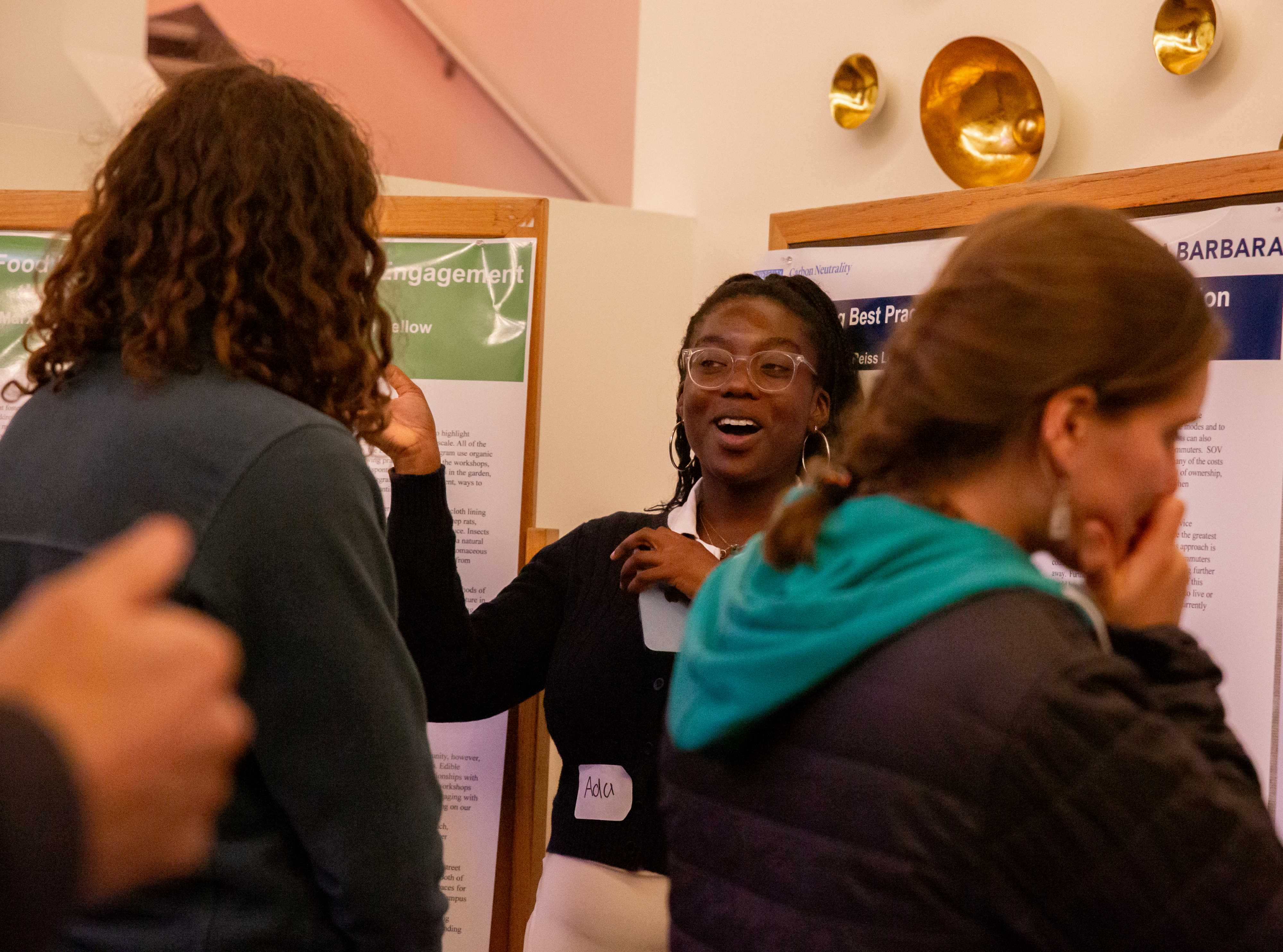
This project involved the creation of a series of sustainable transportation recommendations intended for inclusion in the transportation section of the Climate Action Plan (CAP).The project team offered ideas best suited for significantly reducing the university’s greenhouse gas (GHG) emission output in the areas of commuting and air travel. UC Bonnie Reiss Leading on Climate Action Fellows, Lainey Djajakusuma and Ada Chibueze, with contributions from Rachel Huang, developed a comprehensive “toolkit” of proposed solutions to various transportation challenges that were based on incentive structures, outreach, and behavior change programs. These recommendations were presented to the UCSB Sustainable Transportation Committee and Chancellor’s Sustainability Committee during the 2024-25 school year, and subsequently included in the upcoming 2026 Climate Action Plan.
The effort to evolve and expand the Scope 3 portion of the CAP has been ongoing for several years. Previous interns Anthony Singh and Calvin Weinstock completed an in-depth analysis of Annual Transportation and Commuter Surveys over a ten-year period, using this data to identify areas of transportation that needed improvement. Building on this work, Lainey, Ada, and Rachel began looking into specific recommendations that could fix the issues highlighted in Calvin and Anthony’s research. Initial stages of their project, which began in Summer 2024, involved collecting and analyzing data from the most recent Annual Transportation Survey to lay the foundations of what potential recommendations could look like across different modes of transportation. Lainey focused on active transportation measures such as biking and walking, while Ada focused on air travel.
Upon presenting their recommendations to the Sustainable Transportation Committee and Chancellor's Sustainability Committee, the interns received feedback that allowed them to revise the toolkit to be more practical for the university. An early version of the recommendation toolkit was also presented for Clean Air Day at the Isla Vista Community Services District (IVCSD), which offered members a brief look into what these recommendations could look like beyond UCSB and in the Isla Vista community.
The Short Term Alternative Transit Challenge, also known as the Commute Reset Challenge, emerged from this comprehensive toolkit. The Commute Reset Challenge is a short-term program that rewards participants willing to make the switch away from single-occupancy vehicles and utilize alternative modes of transportation, such as biking, walking, or taking the bus. The challenge, which recently completed its pilot quarter in Fall 2025 and will run a second time in Winter 2026, implemented incentives such as a $60 gift card and other prizes to reward those who successfully complete the challenge and use alternative transportation at least 16 times throughout the quarter.
Partners
- Hillary Blackerby, Santa Barbara MTD
- Nestor Covarrubias, Transportation and Parking Services; Sustainable Transportation Committee
- Ken Hiltner, Sustainable Transportation Committee
- Mariah Hudnut, Transportation & Parking Services
- Katie Maynard, Sustainability Internships and Community Resources
- Jewel Persad, Office of the Vice Chancellor of Administrative Services
- Peter Williamson, Santa Barbara County Association of Governments
Funders
- This project was funded by the UC President’s Bonnie Reiss Fellowship Program.
- The Green Initiative Fund supported the implementation of the recommendation for the Commute Reset Challenge.
Project Leads
- Ada Chibueze
- Lainey Djajakusuma
- Rachel Huang
Ways to Get Involved
Want to participate in the Commute Reset Challenge? Contact Araceli Avina sa-commutechallenge@ucsb.edu for more information.